An old tank in the ground: pull it, fill it in place, or replace it
The tank is only half the story. The soil around it is what decides what happens next.
October 27, 2026 · 3 min read
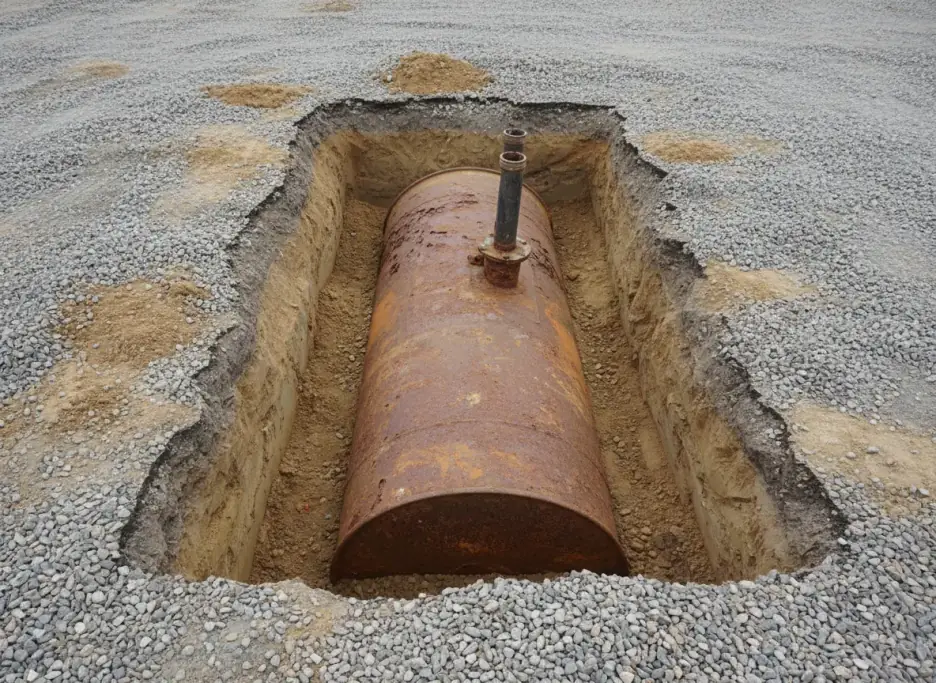
Buried tanks surprise people. A vent pipe pokes out of the lawn behind a house nobody remembers heating with oil. A capped fill port shows up in a driveway slab. An old deed or a neighbor mentions that the lot used to be a service station. Whatever the clue, the same question follows: what do we do about it, and is the ground around it clean?
Signs there may be a tank
- A short pipe or vent sticking out of the ground near a building
- A metal fill cap set in a lawn, driveway or sidewalk
- Supply or return lines running from the foundation out into the yard
- Records or neighbors that point to a former gas station, farm fuel supply, garage or heating oil use
- A patch of ground where grass never grows quite right
None of these proves a tank exists, and none of them proves it leaked. A tank can sit for decades without a drop escaping. The way to know is to locate it, confirm what it is, and look at the soil around it.
Three things you can do with a tank
Indevcon lists UST removal, abandonment and replacement among its site remediation services. They are three different jobs.
Removal means the tank is excavated and taken out of the ground. It is the most direct option, and the one that lets the soil in the pit be seen and sampled. Abandonment means the tank stays where it is, but it is emptied, cleaned and filled so that it is no longer a void or a source of product. That tends to come up when a tank sits under something that cannot easily be moved, like a building or a heavily used pavement. Replacement means the old tank comes out and a new one goes in, which makes sense when you still need underground storage.
Which of these fits depends on where the tank is, what is on top of it, and what the testing shows. Rules about notifying agencies, closure paperwork and who has to do what vary, so ask about the requirements for your property before work starts.
What testing the soil around it means
When a tank comes out, the pit tells a story. Soil that is stained, smells of fuel, or reads high on a field screening instrument gets noticed immediately. But what you see and smell is only part of it. Samples from the walls and floor of the excavation go to a laboratory to be measured for petroleum hydrocarbons, among other things.
If the tank is staying put, or access is tight, soil borings can be used instead of a large excavation. A drill rig takes cores at planned locations around the tank. A monitoring well can be installed where groundwater might be involved, so the water can be sampled over time rather than once.
The result is a map of whether anything got out and how far it went. That is the same sort of work as a Phase Two environmental site assessment, which is why a tank discovered during a property sale often leads straight to one.
If the soil is impacted
Clean soil means you close out the tank and move on. Impacted soil opens up a second set of choices. Indevcon's site remediation toolbox includes soil excavation and removal, on-site treatment of contaminated soil, soil blending, bioremediation, natural attenuation, product recovery, pump and treat systems, soil vapor extraction, air sparging, chemical oxidation and multi-phase extraction.
No site needs all of those. The right approach depends on what the contaminant is, how deep it goes, what the soil is like, and whether groundwater is involved. A shallow, small spill beside a tank pit is a very different project from a plume that has moved under a neighboring property.
For buyers, agents and lenders
A tank found mid-transaction is much easier to deal with if it surfaces in a Phase One than if it surfaces after closing. The Phase One review of records, site features and surrounding history is built to catch clues like these. Indevcon works with real estate agents, brokers, bankers and investors on property transfers, and it can sort out whether a tank is a minor item or something that needs to change the deal.
Start with a free estimate
If you have found a tank, or you suspect one, do not dig on a hunch. Call (815) 758-6896 and talk it through with Glenn. The estimate is free.
Indevcon Inc., (815) 758-6896
Call (815) 758-6896More articles
Before you close: what a Phase One environmental assessment actually reads
A Phase One is mostly reading, asking and walking the property. Here is what goes into it and what it tells you.
A musty basement or a damp attic: what mold testing measures, and why the water matters more
You can scrub a stain away in an afternoon. If the water that fed it is still there, the stain returns.