A musty basement or a damp attic: what mold testing measures, and why the water matters more
You can scrub a stain away in an afternoon. If the water that fed it is still there, the stain returns.
October 27, 2026 · 4 min read
The smell hits you on the basement stairs, or there is a gray-green patch on the ceiling of a bedroom under the attic, or the crawlspace has that cellar odor you notice every time the furnace filter needs changing. Most people reach for a spray bottle. It looks better for a few weeks and then it comes back. Mold is the symptom. Water is the cause, and testing is only half of the answer.
Mold needs three things
Mold needs moisture, something organic to eat, and time. Sheetrock paper, wood framing, insulation facings and household dust all count as food, and you cannot remove all of it from a house. Moisture is the one you can control. That is why a serious mold investigation starts by looking for how water is getting in or building up, before anyone takes a sample.
Common sources include a slow roof leak, a plumbing line that weeps inside a wall, groundwater seeping through a foundation, a downspout that dumps beside the house, warm humid air condensing on a cold surface, a bathroom fan that vents into the attic instead of outdoors, and bare soil in a crawlspace giving off moisture all year.
What mold testing measures
Testing answers specific questions. Indevcon's mold work includes air analysis and surface analysis. Air sampling collects what is floating in a room, usually compared against a sample of the outdoor air taken the same day. Surface sampling, with a swab or a tape lift, tells you what is on a particular stain or material. The lab reports which organisms are present and in what amounts.
Two limits are worth knowing. A single air sample is a snapshot, and results move with weather, activity in the room and the time of day. And a lab number does not interpret itself. It takes someone who has seen the actual building to say what a result means for the people who live or work in it.
The investigation behind the sample
Indevcon describes its mold services as a chain of steps rather than a single test:
- Investigate the sources of moisture intrusion
- Identify the organisms present and their potential to result in adverse health effects
- Delineate the extent of the mold, including what it has reached behind finishes
- Recommend prudent remediation measures
- Prepare specifications for removing the mold and abating the moisture source
- Oversee the work and sample again after remediation
That last step matters. Post-remediation sampling is how you find out whether the cleanup worked, instead of hoping that it did.
Attic, crawlspace, basement: three different problems
In an attic, the usual story is air movement. Warm moist air from the living space or from a bath fan reaches the underside of a cold roof deck, condenses, and the sheathing stays damp. In a crawlspace, the ground itself is the source, along with poor ventilation and wet insulation hanging between the joists. In a basement, look first at the outside: grading that slopes toward the foundation, downspouts, window wells and cracks. Then look at the inside, where a cool concrete wall in a humid month collects condensation on its own.
Each of these has a different fix, and a different set of materials that may need to come out. Tearing out sheetrock does nothing if the downspout is still pouring against the wall behind it.
What remediation looks like
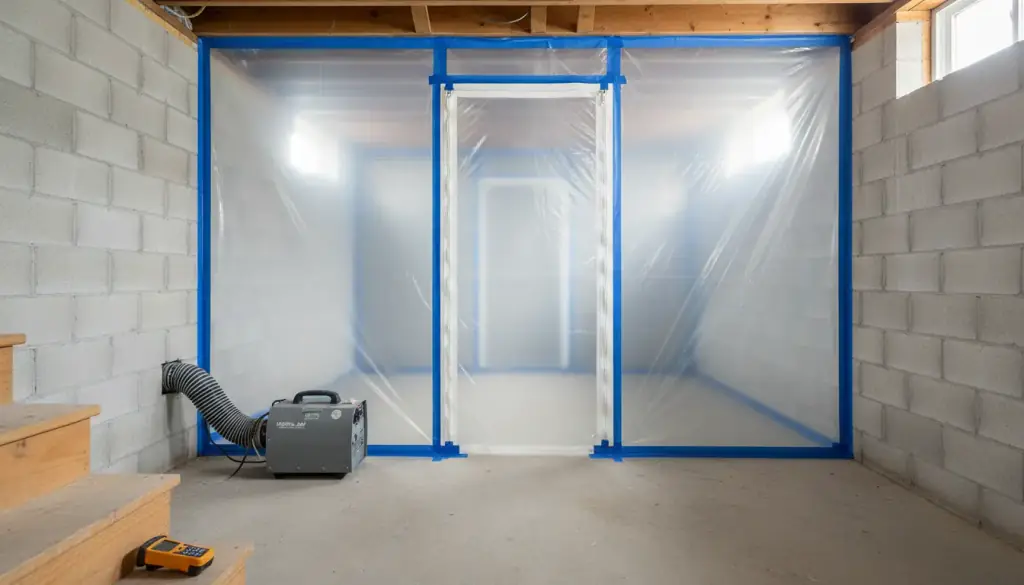
Remediation work is contained. The area is sealed off with poly sheeting, and air filtration with a HEPA machine keeps spores from drifting into the rest of the house. Affected porous materials such as sheetrock are removed. Surfaces that stay are cleaned, treated with a full-spectrum fungal kill, disinfected, and encapsulated. The moisture source is dealt with as part of the same plan, because without that the rest is temporary.
Indevcon puts the stakes this way: mold is a major health hazard for children, seniors, and anyone with allergies, asthma, or a compromised immune system. If someone in your household fits that description, that is a reason to act on the smell instead of waiting.
What to do before anyone arrives
- Note where the smell is strongest and what time of year it gets worse.
- Photograph the stain, and photograph the area around it too.
- Write down recent water events: storms, a plumbing repair, a washing machine overflow.
- Do not scrub, sand or run a fan across the area. That spreads the problem.
- If you can see an active leak and can shut it off safely, do that first.
Then call Glenn at (815) 758-6896 for a free estimate. Indevcon handles the testing and the remediation from one office in DeKalb.
Indevcon Inc., (815) 758-6896
Call (815) 758-6896More articles
Before you close: what a Phase One environmental assessment actually reads
A Phase One is mostly reading, asking and walking the property. Here is what goes into it and what it tells you.
Floor tile, black mastic and pipe wrap: where asbestos still hides in an older building
You cannot identify asbestos by looking at it. You can find out before the demolition starts.