Floor tile, black mastic and pipe wrap: where asbestos still hides in an older building
You cannot identify asbestos by looking at it. You can find out before the demolition starts.
October 27, 2026 · 3 min read
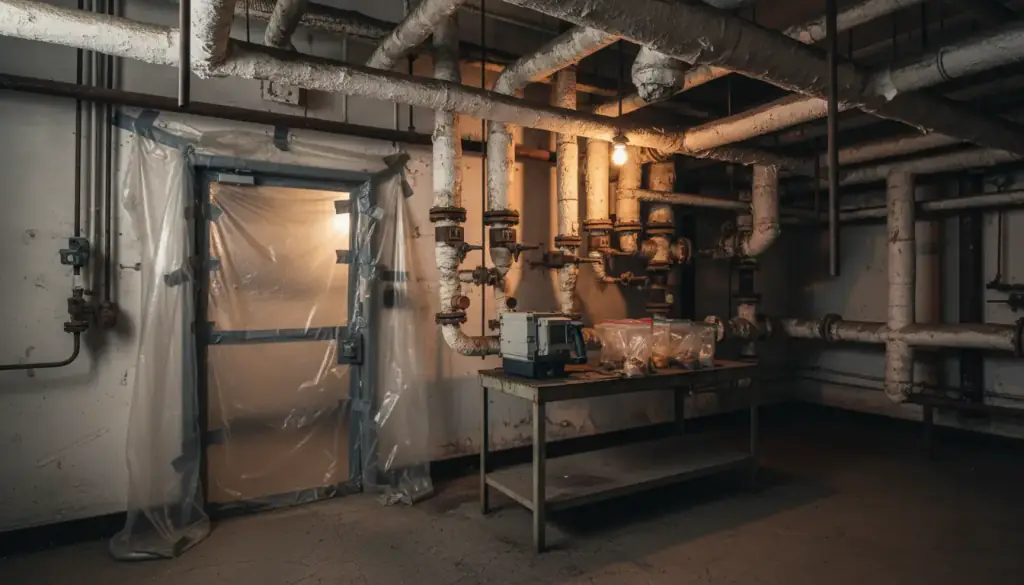
You are about to pull up the old kitchen floor, or open a wall to move a pipe, or gut a basement that has not been touched in decades. The question to ask first is a short one: do we know what these materials are made of? In an older building, the honest answer is often no, and the time to find out is before anything is cut, scraped or smashed.
Asbestos is no longer a common choice for new construction, but it has not gone anywhere. A great deal of it is still sitting in older houses, schools, shops and industrial buildings, usually doing nothing until a renovation disturbs it.
The usual hiding places
Indevcon's asbestos work points to the same set of materials again and again:
- Floor tile, linoleum and the mastic, the dark adhesive underneath them
- Boiler insulation
- Pipe insulation and the wrapped fittings at elbows and joints
- Roofing materials
- Siding
Floors deserve a second look because they stack up. A newer vinyl or carpet can sit on top of an older tile, and the old layer is still there, still glued down. Pipe wrap is easy to miss too. It turns up in basement ceilings, in utility rooms and in attics, and it often looks like plain gray or white paper or cloth wrapping.
Why looking does not work
Asbestos-containing material looks like ordinary material. A tile that contains it and a tile that does not can be identical on the surface. The only way to know is to take a sample and have a laboratory analyze it. That is why sampling comes before the renovation plan rather than after the first surprise.
It is also why a sample should be taken carefully. Cutting a piece out of a pipe wrap or prying up a tile is exactly the kind of disturbance you are trying to avoid. A trained inspector knows how to collect it while keeping fibers from becoming airborne, and how many samples a given room or system needs, because each material is judged separately.
What the testing and survey side includes
Indevcon's asbestos services cover the testing side as well as the work that follows from it. On the inspection side that means inspections and surveys, sampling, AHERA inspections and management plans, and lead inspections and risk assessments. Lead is worth bundling into the same visit on older properties, since old paint and old tile often come up together. For lead in paint, an XRF analyzer can read a surface directly, with no paint scraped off the wall.
If the results come back positive
A positive result does not automatically mean a crisis. What happens next depends on where the material is, what condition it is in, and what you plan to do. Material that is intact and left alone can sometimes be managed in place with an operation and maintenance plan, which tells everyone who works in the building where it is and how to avoid disturbing it. Material in the path of your renovation is a different matter, and that is where abatement comes in.
Indevcon's work past testing includes preparing plans and specifications, evaluating contractor bids and making a recommendation, and abatement project monitoring and oversight. What rules apply to your project depends on the building and the scope, so ask about the requirements for your property before you set a schedule.
Who should think about this early
- Homeowners planning a kitchen, bath or basement remodel in an older house
- Buyers who intend to renovate right after closing
- Property managers and owners opening up boiler rooms, mechanical spaces or roofs
- Agents, brokers and bankers working a transfer where the building is old and the plan is to change it
For buyers and investors, asbestos-containing materials are also one of the items a Phase One environmental site assessment looks at, so the question often gets answered during due diligence instead of during demolition.
A phone call is the cheapest first step
Estimates are free. Call (815) 758-6896 and describe the building, the materials you are worried about and what you want to change. Glenn will tell you what sampling makes sense before you pick a start date.
Indevcon Inc., (815) 758-6896
Call (815) 758-6896More articles
Before you close: what a Phase One environmental assessment actually reads
A Phase One is mostly reading, asking and walking the property. Here is what goes into it and what it tells you.
A musty basement or a damp attic: what mold testing measures, and why the water matters more
You can scrub a stain away in an afternoon. If the water that fed it is still there, the stain returns.